We all know that one of the people who nearly made it on the cover of "Sgt. Pepper's Lonely Hearts Club Band" was Adolf Hitler. You can see Hitler's image in this
video of shots from the photo session.

Hitler's presence, of course, would have alienated some Beatles fans, but are there other people in that group on the cover who shared similar views when it came to racism, antisemitism or the Eugenics movement?

Some people consider Karl Marx's work "
On The Jewish Question" to be antisemitic.

Although he didn't target a specific group of people,
George Bernard Shaw said some shocking things about people "who are more trouble than they are worth."

H.G. Wells was a believer in Eugenics.

In discussing Francis Galton's work, H.G. Wells said,
"I believe .. It is in the sterilization of failure, and not in the selection of successes for breeding, that the possibility of an improvement of the human stock lies."Aldous Huxley wrote:
So far as our knowledge goes, negative eugenics - or the sterilisation of the unfit - might already be practised with tolerable safety. On the positive side we are still very ignorant - though we know enough thanks to Mr Fisher's admirable work, to foresee the rapid deterioration, unless we take remedial measures, of the whole West European stock. Eugenics are not yet practical politics. But propaganda could easily make them practical politics, while increase in knowledge will make them also purposive and far-sighted politics. (
Source)

I guess it all depends on whether you see Huxley's "Brave New World" as a warning or a blueprint.
Sir Robert Peel had an interest in Genetics (and probably Eugenics) and is even credited for the development of the
Tamworth Pig.

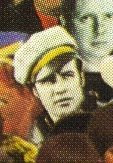
Marlon Brando portrayed a scientist performing eugenic experiments in the film "ISLAND OF DR MOREAU," which was based on a story by H.G. Wells.
According to the book "
Controversies in Psychology" by Philip Banyard, Sigmund Freud (partially obscured on the cover of Sgt. Pepper) believed that
"it is possible to divide people into leaders and those who are led. The led 'constitutes the vast majority: they need a high command to make decisions for them, and to which they for the most part offer an unqualified submission.'" Banyard said that Freud advocated educating the best and brightest to lead the masses.

Freud's colleague C.G. Jung was accused of having sympathy for the Nazis, especially after he said,
"Hitler belongs in the category of the truly mystic medicine man. His body does not suggest strength. The outstanding characteristic of his physiognomy is its dreamy look. I was especially struck by that when I saw pictures taken of him in the Czechoslovakian crisis; there was in his eyes the look of a seer. This markedly mystic characteristic of Hitler's is what makes him do things which seem to us illogical, inexplicable, and unreasonable."
Jung vehemently denied accusations that he was a Nazi sympathizer.
Eugenics devotee Edgar Rice Burroughs is not on the cover of Sgt. Pepper, but his creation Tarzan is.

In his memoir, Tony Curtis felt the need to clarify his well publicized comment that kissing Marilyn Monroe was like kissing Hitler.

Curtis wrote:
“After the scene on the yacht, some of the crew and I stood around to watch the rushes, and afterwards they wanted to know what it was like to kiss her. I figured a question that stupid deserved a stupid answer, so I flippantly responded by saying, ‘Kissing Marilyn is like kissing Hitler.’ I was right—it was a stupid answer. What I should have said was ‘What do you think kissing her is like, birdbrain?’ Or I could have had the good sense to just say nothing. But my thoughtless comment became public knowledge, and the story still makes the rounds. So let me set the record straight once and for all: I hated Hitler. As a Jewish kid in New York, I threw condom bombs on pro-Nazi parades. I loved Marilyn Monroe. And she was a terrific kisser.”
If this all sounds like a conspiracy tabloid, please remember that I am resisting the temptation to suggest that Marilyn Monroe was a victim of Operation Monarch, a CIA project involving former Nazi scientists. I also won't say anything about rumors that actor Errol Flynn was a bisexual Nazi spy who had an affair with Sgt. Pepper character Tyrone Power. And if you look hard enough, you can find a we
bsite that claims that Hitler was replaced by Aleister Crowley. I refuse to stoop that low even in the month of April.

It is important to note that The Beatles were once unfairly accused of being racist when someone dug up an ancient outtake from the "Get Back" sessions.

John Lennon was once questioned about an unfortunate remark that he allegedly made to Maureen Cleave regarding a relationship between show business and the Jewish religion. Journalist Larry Kane said that he was once angered by a slur about Jewish people from the back of a plane where the Beatles and Derek Taylor were seated. Kane seemed to believe that one of the Beatles said it even though Derek Taylor took the blame. But there is very little evidence that any of the Beatles really believed in any kind of racial or ethnic superiority.
There are in fact several people on the cover of "Sgt. Pepper" who fought for human rights, including Marilyn Monroe, Shirley Temple, and Marlon Brando (not to mention John, Paul, George and Ringo). Albert Einstein was hated by the Nazis. Marlene Dietrich, star of "Judgment at Nuremberg" recorded anti-Nazi songs. It is just that whenever you try to find connections between some of the individuals on the Sgt. Pepper cover, some surprising patterns emerge.


